Establishes the general requirements for documentation necessary to fully describe end product printed boards, regardless of raw material, special fabrication requirements, layer count or end product usage. Includes master drawing requirements, board definition and artwork/phototooling. 94 pages. Revised May 1995.
IPC-2222B used in conjunction with IPC-2221, establishes the specific requirements for the design of rigid organic printed boards and other forms of component mounting and interconnecting structures. The IPC-2222B standard applies to single-sided, double-sided, or multi-layered boards. Key concepts in IPC-2222B are rigid laminate properties, design requirements for printed board assembly and...
The IPC-7525C standard provides guidance for the design and fabrication of stencils for solder paste and surface-mount adhesive with much of the content based on the experience of stencil designers, fabricators, and users.
This document provides useful and practical information for developing thermal profiles to produce acceptable SnPb and Pb-free electronics assemblies using reflow, vapor phase, laser, selective and wave soldering equipment. The document also includes a troubleshooting guide for addressing common defects which can be attributed to profiling.
EIA/IPC/JEDEC-J-STD-075 - Revision A - Standard Only
EIA/IPC/JEDEC J-STD-075 picks up where J-STD-020 left off by providing test methods to classify worst-case thermal process limitations for electronic components. Classification is referenced to common industry wave and reflow solder profiles including lead-free processing. The classifications represent maximum process sensitivity levels and do not establish rework conditions or recommended...
UPDATED! This standard describes a data format for transmitting bare board electrical test information in digital form, including data suitable for computer-aided repair. When used as a netlist input to test data processing, the receiver of IPC-D-356B data will determine test point assignments and positioning. Enhancements to the B Revision include updates to the concept of testable areas to...
IPC-2226A, Sectional Design Standards for High Density Interconnect (HDI) Printed Boards is used in conjunction with IPC-2221B. The IPC-2226A standard establishes requirements and considerations for the design of high density interconnect (HDI) printed boards and microvia technology. Revision A constitutes a substantial update to the document, with an all new color key for HDI constructions, new...
IPC-4562A standard covers metal unsupported foils and foils supported by carrier films suitable for subsequent use in printed boards. IPC-4562B addresses the requirements of metal foils used in printed wiring applications.
IPC-7526A handbook addresses understencil cleanliness during stencil printing, removal of solder paste from stencils following the cleaning process and misprint PCB board cleaning considerations.
Developed by the OEM council of the IPC, IPC-1720A categorizes electronic assembly manufacturer capabilities and supplies the OEM customer with detailed, substantive information. This program simplifies auditing processes and reduces the frequency of audits, thereby decreasing paperwork and improving efficiency. Company and Site Description, Site Capability Snap Shot, Equipment Profile (Pre-site...
Covers the information requirements for the procurement of material, box build, assembly, system integration, inspection, test, burn-in, delivery and/or distribution of electronic assemblies. 5 pages. Released January 2004.
IPC-4204B establishes the classification system, the qualification and quality performance requirements for flexible metal-clad dielectric materials to be used for the fabrication of flexible printed boards. It encompasses 12 specification sheets that result from the combinations of various copper foil claddings; a polymer base dielectric selected from polyesters, polyimides, liquid crystal...
The IPC-1752B standard establishes the requirements for exhanging material and substance data between suppliers and their customers for electrical and electronics products and other produicts. IPC-1752B includes data fields to help supply chain members transfer materials data required for submission into the ECHA SCIP database.
Amendment 1 to IPC-1751A standard provides the principles and details for declarations necessary between members of a supply chain relationship. This standard is the first in a series of standards that permits segmentation of declaration details based on the subject and scope of the declaration as well as the manufacturing domain. This standard contains general information and is supplemented by...
This specification sets requirements based on performance criteria for the use of Immersion Silver (IAg) as a surface finish for printed circuit boards. It is intended for use by chemical suppliers, printed board manufacturers, electronics manufacturing services (EMS) companies and original equipment manufacturers (OEM). IAg is a thin immersion deposit over copper. It is a multifunctional surface...
IPC-9252 defines levels of appropriate testing and assists in the selection of the test analyzer, test parameters, test data and fixturing required to perform electrical test(s) on unpopulated printed boards and innerlayers. Revision B provides new requirements for resistive and indirect continuity and isolating testing, test record marking and traceability and an updated sample electrical test...
This standard provides a marking and labeling system that aids in assembly, rework, repair and recycling and provides for the identification of: 1. those assemblies that are assembled with lead-containing or lead-free solder; 2. components that have lead-containing or lead-free second level interconnect terminal finishes and materials; 3. the maximum component temperature not to be exceeded during...
This standard is applicable to suppliers of, and affected customers for, electronic products and their constituent components. The goal of this notification standard is to better enable customers to manage and mitigate the disruption caused by the discontinuation of a product and to ensure continuity of supply. This standard establishes the requirements for timely customer notification of planned...
IPC-J-STD-004C - Revision C - Standard with Amendment 1
The IPC J-STD-004C WAM1 standard prescribes general requirements for the classification and characterization of fluxes for high quality solder interconnections. The IPC J-STD-004C WAM1 standard may be used for quality control and procurement purposes. Soldering flux materials include the following: liquid flux, paste flux, solder paste, solder cream as well as flux-coated and flux-cored solder...
IPC-2292A standard establishes specific requirements for the design of printed electronic applications and their forms of component mounting and interconnecting structures on flexible substrates. Flexible substrates, as pertaining to IPC-2292A standard, are materials, devices or functionalized circuitry which have some amount of flexibility or bendability (not rigid) but are not considered to be...
The IPC-D-640A standard provides design and critical process requirements and technical insight for cable and wire harness assemblies incorporating optical fiber, optical cable and hybrid wiring technology. The IPC-D-640A standard is intended to provide information on the general design requirements for optical fiber, optical cable, hybrid wiring harness assemblies, and Fiber Optic Communications...
While there are a variety of industry test vehicles for the examination of material compatibility, the IPC-B-52 test board was created to meet the needs for testing both ion chromatograph and surface insulation resistance (SIR) which would be more representative of the manufacturing materials and processes. IPC-9203A standard addresses the IPC-B-52 test vehicle, which can be used to evaluate a...
IPC/JEDEC J-STD-035A test method defines the procedures for performing acoustic microscopy on nonhermetic encapsulated electronic devices. IPC/JEDEC J-STD-035A method provides users with an acoustic microscopy process flow for detecting anomalies (delaminations, cracks, mold compound voids, etc.) nondestructively in encapsulated electronic devices while achieving reproducibility
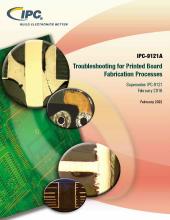
The IPC-1921A handbook provides problems, causes and possible corrective actions related to printed board manufacturing processes. Includes more than 200 photos and illustrations depicting common defects.