Close

Standards

Products

IPC-A-610 - Revision D - Addendum - Telecom

IPC-A-610DC-Telecom Addendum

Document #:
Revision
D
Product Type
Released:  08/01/2009
Language
English
Telecom Addendum to IPC-A-610D Acceptability of Electronic Assemblies Telecom Addendum Published August 2009. When specifically required by procurement documentation, this Addendum supplements or replaces specifically identified requirements of IPC-A-610, Revision D of February 2005 by providing additional requirements to ensure compliance to GR-78-CORE.
Document #:
Revision
Original Version
Product Type
Released:  04/07/2020
Language
English
The IPC-1602 standard provides requirements intended to protect printed boards from contamination, physical damage, solderability degradation and moisture uptake. Consideration is given to packaging materials types and methods, production environment, handling and transport of product, and establishing baking profiles for moisture removal. IPC-1602 is now providing requirements that can be called...

IPC-2291 - Standard Only

Design Guideline for Printed Electronics

Document #:
Revision
Original Version
Product Type
Released:  07/30/2013
Language
English
This guideline provides an overview of the design process flow for printed electronics based devices, modules and units, and final products.The intent of IPC/JPCA-2291 is to establish a design process flow that will facilitate and improve the practice of printed electronics design. IPC/JPCA-2291 identifies documents such as standards that can be used to assist during the design process flow. 24...
Document #:
Revision
Original Version
Released:  06/26/2013
Language
English
In answer to numerous industry requests for guidance on electroless nickel/immersion gold (ENIG), IPC-4552 was developed. Containing full color photographs, this specification sets the requirements for the use of ENIG as a surface finish for printed boards. It includes requirements for ENIG deposit thicknesses based on performance criteria. It is an invaluable resource for use by suppliers, board...
Document #:
Revision
Original Version
Product Type
Released:  07/01/2006
Language
English
IPC-4761 is the sole industry guideline providing PCB designers, manufacturers and uses with detailed information on all existing methods for protecting vias on printed boards, including all types of via tenting, plugging, filling and capping. Production issues, long term reliability concerns and material specification and selection are provided to aid in evaluating the benefits and concerns for...
Document #:
Revision
Original Version
Released:  08/10/2012
Language
English
IPC-4554, Specification for Immersion Tin Plating for Printed Circuit Boards, is included in the IPC-455X series of specifications that set the requirements for printed board surface finishes that are alternates to non-coplanar finishes, most often referred to as tin-lead HASL finish. This specification is a full-color document that is intended for use by the supplier or printed board fabricator...
Document #:
Revision
Original Version
Product Type
Released:  02/05/2013
Language
English
This specification sets the requirements for the use of electroless nickel/electroless palladium/immersion gold (ENEPIG) as a surface finish for printed boards. It establishes requirements for ENEPIG deposit thicknesses for applications including soldering, wire bonding and as a contact finish. It is intended for use by chemical suppliers, printed board manufacturers, electronics manufacturing...
Document #:
Revision
Original Version
Product Type
Released:  08/02/2022
Language
English
The IPC/DAC-2552 standard was developed jointly with the Digital Association of China (DAC), with the purpose to use Model Based Definition (MBD) to realize efficient and high-quality digital design of board-level assembly, support electronic assembly virtual manufacturing, and enabling the digitalization from requirement to product realization for printed board assemblies. The IPC/DAC-2552...
Document #:
Revision
Original Version
Product Type
Released:  04/30/2010
Language
English
This standard establishes the generic requirements for a document set describing electronic products, and the methodology used for revision control and configuration management of the information. The generic descriptions apply to the entire document set and are used to define and maintain the electronic product. The methodology permits different grades of completeness of the documentation, as...
Document #:
Revision
Original Version
Product Type
Released:  05/01/2001
Language
English
During mass soldering, it is important that all solder joints reach the minimum soldering (reflow) temperature to assure metallurgical bonding of the solder alloy and the base metals to be soldered. Metallurgical bonding requires that both surfaces to be soldered, as well as the solder, reach this minimum soldering temperature for a sufficient time to allow the wetting of the solder surfaces. This...
Document #:
Revision
Original Version
Product Type
Released:  11/01/2003
Language
English
This guideline addresses the major factors influencing the design of high-speed circuitry. Considerations include electrical noise, electromagnetic interference, signal propagation time, impedance, thermo-mechanical environmental protection, and heat dissipation. Supersedes IPC-D-317A. Key improvements over the IPC-D-317A document include updated impedance models for embedded microstrip, centered...
Document #:
Revision
Original Version
Product Type
Released:  06/01/2000
Language
English
Published jointly with the Japan Printed Circuits Association, IPC/JPCA-2315 provides an easy to follow tutorial on the selection of HDI and microvia design rules and structures. Addresses various considerations when designing an HDI printed wiring board including design examples and processes, selection of materials, general descriptions, and various microvia technologies. Offers designers and...
Document #:
Revision
Original Version
Product Type
Released:  03/18/2009
Language
English
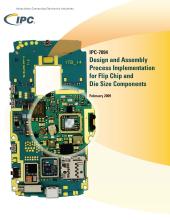
Implementing flip chip technology in a direct chip attach (DCA) assembly presents some unique challenges for design, assembly, inspection and repair personnel. IPC-7094 delivers useful and practical information to anyone who is currently using or contemplating developing products that employ the very complex and high density methods needed for the flip chip technology. The concepts have become...
Document #:
Revision
Original Version
Product Type
Released:  07/01/1996
Language
English
This document establishes the requirements and interactions necessary for printed board assembly processes for interconnecting high performance/high pin count IC packages. Includes information on design principles, material selection, board fabrication, assembly technology, testing strategy and reliability expectations based on end-use environments. Developed by IPC, EIA, MCNC and Sematech. 96...
Document #:
Revision
Original Version
Product Type
Released:  12/08/2015
Language
English
IPC-D-620 provides design and critical process requirements for the three product classes of cable and wire harness assemblies as well as military/space applications. It is the design requirements companion to IPC/WHMA-A-620, "Requirements and Acceptance for Cable and Wire Harness Assemblies," and its associated Space Addendum Three white papers are included to provide guidance on key topics...

IPC-A-610 - Revision G - Redline Standard

Acceptability of Electronic Assemblies-Redline

Document #:
Revision
G
Product Type
Released:  10/31/2017
Language
English
This is a redline document showing the changes from IPC-A-610F with Amendment 1 to IPC-A-610G. This document provides a side-by-side comparison of the two documents and includes the figures and tables. The document shows the deleted/changed text in the IPC-A-610F with Amendment 1 pages and the new/revised text in purple highlights in the IPC-A-610G pages. Yellow pop-up boxes are also present in...

IPC-A-610 - Revision F - Redline Standard

IPC-A-610 Revision E to Revision F Redline Comparison Document

Document #:
Revision
F
Product Type
Released:  10/21/2014
Language
English
IPC-A-610 Revision E to Revision F Redline Comparison Document. This document is free to Task Group members participating in development of the standard and to Certification Centers with current training licenses for the associated Training and Certification program. CITs who are not members of the Task Group are encouraged to contact his or her MIT for a copy of the redline document.
Document #:
Revision
Original Version
Product Type
Released:  10/20/2011
Language
English
This document provides tests that record changes in surface insulation resistance (SIR) on a representative sample of a printed circuit assembly. It quantifies any deleterious effects that might arise from solder flux or other process residues left on external surfaces after soldering, which can cause unwanted electrochemical reactions that grossly affect reliability. It uses test vehicles that...
Document #:
Revision
Original Version
Product Type
Released:  04/27/2012
Language
English
While there are a variety of industry test vehicles for the examination of materials compatibility, most available test boards leave something to be desired as there is often a dramatic difference in materials between such test boards and produced assemblies. A test vehicle was needed which could be used for both ion chromatography and SIR testing that would be more representative of mainstream...
Document #:
Revision
Original Version
Product Type
Released:  02/01/2016
Language
English
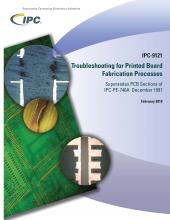
This handbook is an essential resource for anyone involved in manufacturing or purchasing PCBs. Hundreds of real-world, full-color photos spotlight more than 650 PCB process defects, with causes and corrective actions for each. IPC-9121 supersedes the PCB sections of IPC-PE-740A. Released March 2016
Document #:
Revision
Original Version
Product Type
Released:  02/13/2007
Language
English
Cleaning of stencils and misprinted PCBs has taken an increasingly important role in surface mount technology. Fine and ultra-fine pitch lands, together with other advanced packages, place new demands on stencil cleaning. Paste volume is a critical issue for fine, ultra-fine, chip-scale, BGA and flip-chip components. Insufficient solder due to clogging of stencil apertures is a primary cause of...

Coming Soon

IPC-9242: Guidelines for Microsection Evaluation

IPC-9691C: User Guide for the IPC-TM-650, Method 2.6.25 Conductive Anodic Filament (CAF) Resistance and Other Internal Electrochemical Migration Testing

IPC-A-630A: Acceptability Standard for Manufacture, Inspection, and Testing of Electronic Enclosures

IPC-4556A: Specification for Electroless Nickel/Electroless Palladium/ Immersion Gold (ENEPIG) Plating for Printed Boards

IPC-7527A: Requirements for Solder Paste Application

IPC-4204C: Flexible Metal-Clad Dielectrics for Use in Fabrication of Flexible Printed Boards

IPC-J-STD-002F: Solderability Tests for Component Leads, Terminations, Lugs, Terminals and Wires

IPC-4101F: Specifications for Base Materials for Rigid and Multilayer Printed Boards

IPC-1755B: Responsible Sourcing of Minerals Data Exchange Standard

IPC-2223F: Sectional Design Standard for Flexible/Rigid-Flexible Printed Boards

IPC-HDBK-9798A: Handbook and Guide to Supplement IPC-9797

IPC-WP-011: Guidance for Strain Gage Limits for Assemblies

J-STD-046A: Customer Notification Standard for Product/Process Changes by Electronic Product Suppliers

J-STD-048A: Notification Standard for Product Discontinuance

IPC-T-50P: Terms and Definitions for Interconnecting and Packaging Electronic Circuits

IPC-1401B: Corporate Social Responsibility Management System Standard

IPC -1751B: Generic Requirements for Declaration Process Management

IPC-6013F: Qualification and Performance Specification for Flexible/Rigid-Flexible Printed Boards

IPC-4413 - Am1: Specification for Finished Fabric Woven from Low Dk Glass for Printed Boards