Close

Standards

Products

Document #:
Revision
Original Version
Product Type
Released:  09/13/2011
Language
English
This standard on spherical transient bend testing is intended to characterize the maximum allowable strain that a surface mount component's board level interconnects can withstand in flexural loading. Whereas four-point monotonic bend test methods only address simple planar bending, spherical bend tests establish strain limits of board level interconnects under worst-case flexure conditions that...
Document #:
Revision
Original Version
Released:  08/10/2012
Language
English
IPC-4554, Specification for Immersion Tin Plating for Printed Circuit Boards, is included in the IPC-455X series of specifications that set the requirements for printed board surface finishes that are alternates to non-coplanar finishes, most often referred to as tin-lead HASL finish. This specification is a full-color document that is intended for use by the supplier or printed board fabricator...
Document #:
Revision
Original Version
Product Type
Released:  02/05/2013
Language
English
This specification sets the requirements for the use of electroless nickel/electroless palladium/immersion gold (ENEPIG) as a surface finish for printed boards. It establishes requirements for ENEPIG deposit thicknesses for applications including soldering, wire bonding and as a contact finish. It is intended for use by chemical suppliers, printed board manufacturers, electronics manufacturing...
Document #:
Revision
Original Version
Product Type
Released:  06/21/2022
Language
English
Current Revision
IPC-HDBK-9798 provides guidelines and supporting information for manufacturing electronic assemblies using compliant press-fit technology. The intent is to explain the ‘‘how-to’’ and ‘‘why’’ information, and fundamentals for these processes. This handbook is supporting the IPC-9797 standard.
Document #:
Revision
Original Version
Product Type
Released:  06/01/2020
Language
English
IPC-9797 is the only industry-consensus standard for Requirements and Acceptance of Press-fit Pins. IPC-9797 prescribes practices for the characterization, qualification and acceptance requirements of compliant press-fit technology for printed boards that cover the manufacturability and reliability needs for high reliability applications intended for use in harsh environments such as automotive...
Document #:
Revision
Original Version
Product Type
Released:  12/01/2005
Language
English
This standard describes the methods of inspecting and cleaning all optical interfaces so that interconnectivity integrity of the optical signal is maintained. The information provided focuses on techniques and methods to accomplish maximum quality of the interface and describes methods of contamination prevention. The target audience for this standard are Manufacturing Operators, Manufacturing...

IPC-MS-810 - Standard Only

Guidelines for High Volume Microsection

Document #:
Revision
Original Version
Product Type
Released:  10/01/1993
Language
English
Discusses the many variables and problems associated with the process--from sample removal to micro-etch-- and the variables common to high volume microsection. The process variables and problems are organized so that the reader can research a specific issue or overview the variables of a process area. 31 pages. Released October 1993.
Document #:
Revision
Original Version
Product Type
Released:  12/15/2010
Language
English
IPC-9631 addresses concerns and considerations related to IPC-TM-650, Method 2.6.27, Thermal Stress, Convection Reflow Assembly Simulation. This document describes how the test method is intended for use and the rationale behind some of the protocols and requirements. This document was developed with the understanding that the test method will require special equipment and the proper set-up and...
Document #:
Revision
Original Version
Product Type
Released:  03/18/2009
Language
English
Establishes mechanical drop and shock and test guidelines for assessing solder joint reliability of printed board assemblies from system to component level. This document addresses methods to define mechanical shock use-conditions, methods to define system level, system printed board level and component test board level testing that correlate to such use conditions and guidance on the use of...
Document #:
Revision
Original Version
Product Type
Released:  05/01/2001
Language
English
During mass soldering, it is important that all solder joints reach the minimum soldering (reflow) temperature to assure metallurgical bonding of the solder alloy and the base metals to be soldered. Metallurgical bonding requires that both surfaces to be soldered, as well as the solder, reach this minimum soldering temperature for a sufficient time to allow the wetting of the solder surfaces. This...
Document #:
Revision
Original Version
Product Type
Released:  03/18/2009
Language
English
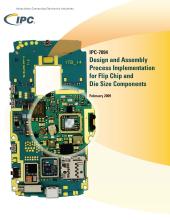
Implementing flip chip technology in a direct chip attach (DCA) assembly presents some unique challenges for design, assembly, inspection and repair personnel. IPC-7094 delivers useful and practical information to anyone who is currently using or contemplating developing products that employ the very complex and high density methods needed for the flip chip technology. The concepts have become...
Document #:
Revision
Original Version
Product Type
Released:  11/01/1992
Language
English
Guidelines for accelerated reliability testing of surface mount solder attachments when evaluating and extrapolating the results of these tests towards actual use environments of electronic assemblies. 50 pages. Released November 1992. Included in the IPC-C-103 and the IPC-C-1000 Collections
Document #:
Revision
Original Version
Product Type
Released:  04/01/1999
Language
English
This test method defines the procedures for performing acoustic microscopy on non-hermetic encapsulated electronic components. It provides users with an acoustic microscopy process flow for detecting defects non-destructively in plastic packages while achieving reproducibility. Developed by IPC and JEDEC. 16 pages. Released April 1999. Equivalent to IEC Publicly Available Specification (PAS) 62191

IPC/WHMA-A-620 - Revision E - Redline Standard

Requirements and Acceptance for Cable and Wire Harness Assemblies

Document #:
Revision
E
Product Type
Released:  03/06/2023
Language
English
IPC/WHMA-A-620E-RL is a redline document showing the difference from IPC/WHMA-A-620D to IPC/WHMA-A-620E. IPC/WHMA-A-620E-RL provides a side-by-side comparison of the two documents and includes the figures and tables. The document shows deleted/changed text in the IPC/WHMA-A-620D pages and new/revised text in the IPC/WHMA-A-620E pages. Due to the complexity of this document, it is only available in...

IPC-A-610 - Revision G - Redline Standard

Acceptability of Electronic Assemblies-Redline

Document #:
Revision
G
Product Type
Released:  10/31/2017
Language
English
This is a redline document showing the changes from IPC-A-610F with Amendment 1 to IPC-A-610G. This document provides a side-by-side comparison of the two documents and includes the figures and tables. The document shows the deleted/changed text in the IPC-A-610F with Amendment 1 pages and the new/revised text in purple highlights in the IPC-A-610G pages. Yellow pop-up boxes are also present in...

IPC-A-610 - Revision F - Redline Standard

IPC-A-610 Revision E to Revision F Redline Comparison Document

Document #:
Revision
F
Product Type
Released:  10/21/2014
Language
English
IPC-A-610 Revision E to Revision F Redline Comparison Document. This document is free to Task Group members participating in development of the standard and to Certification Centers with current training licenses for the associated Training and Certification program. CITs who are not members of the Task Group are encouraged to contact his or her MIT for a copy of the redline document.
Document #:
Revision
Original Version
Product Type
Released:  10/20/2011
Language
English
This document provides tests that record changes in surface insulation resistance (SIR) on a representative sample of a printed circuit assembly. It quantifies any deleterious effects that might arise from solder flux or other process residues left on external surfaces after soldering, which can cause unwanted electrochemical reactions that grossly affect reliability. It uses test vehicles that...
Document #:
Revision
Original Version
Product Type
Released:  09/13/2011
Language
English
Surface mount pad cratering typically initiates prior to detection by existing electrical monitoring test methods. There are limited instrumentation techniques that are currently available that can identify non-electrical damage and its location to a high degree of accuracy. This guideline document establishes an acoustic emission (AE) method to evaluate the performance and reliability of surface...
Document #:
Revision
Original Version
Product Type
Released:  04/27/2012
Language
English
While there are a variety of industry test vehicles for the examination of materials compatibility, most available test boards leave something to be desired as there is often a dramatic difference in materials between such test boards and produced assemblies. A test vehicle was needed which could be used for both ion chromatography and SIR testing that would be more representative of mainstream...
Document #:
Revision
Original Version
Product Type
Released:  02/13/2007
Language
English
Cleaning of stencils and misprinted PCBs has taken an increasingly important role in surface mount technology. Fine and ultra-fine pitch lands, together with other advanced packages, place new demands on stencil cleaning. Paste volume is a critical issue for fine, ultra-fine, chip-scale, BGA and flip-chip components. Insufficient solder due to clogging of stencil apertures is a primary cause of...
Document #:
Revision
Original Version
Product Type
Released:  03/28/2011
Language
English
This standard describes the design and assembly challenges for implementing Bottom Termination surface mount Components (BTCs) whose external connections consist of metallized terminals that are an integral part of the component body. The BTCs in this document include all types and forms of bottom-only termination components intended for surface mounting. This includes such industry descriptive...
Document #:
Revision
Original Version
Product Type
Released:  03/19/2009
Language
English
This new standard supplements existing IPC-6010 series specifications with qualification and performance requirements for in-process and finished printed boards containing embedded passive circuitry (distributive capacitive planes and capacitive or resistive components). 10 pages. Released March 2009. Included in Collections C-105, C-1000 and the 6010 Series
Document #:
Revision
Original Version
Product Type
Released:  09/25/2017
Language
English
The IPC-7091 intends to provide useful and practical information to those who are designing, developing or using 3D-packaged semiconductor components or those who are considering 3D package implementation. The 3D semiconductor package may include multiple die elements—some homogeneous and some heterogeneous. The package may also include several discrete passive SMT devices, some of which are...
Document #:
Revision
D
Product Type
Released:  10/30/2015
Language
English
Track the substantive changes in IPC-6012D with this redline product. This is the D revision in its entirety, with each change highlighted on the page. Click the text to launch a pop-up with an explanation of the change from the C revision. Available for download only. IPC-6012D covers qualification and performance of rigid printed boards, including single-sided, double-sided, with or without...

Coming Soon

IPC-9242: Guidelines for Microsection Evaluation

IPC-9691C: User Guide for the IPC-TM-650, Method 2.6.25 Conductive Anodic Filament (CAF) Resistance and Other Internal Electrochemical Migration Testing

IPC-A-630A: Acceptability Standard for Manufacture, Inspection, and Testing of Electronic Enclosures

IPC-4556A: Specification for Electroless Nickel/Electroless Palladium/ Immersion Gold (ENEPIG) Plating for Printed Boards

IPC-7527A: Requirements for Solder Paste Application

IPC-4204C: Flexible Metal-Clad Dielectrics for Use in Fabrication of Flexible Printed Boards

IPC-J-STD-002F: Solderability Tests for Component Leads, Terminations, Lugs, Terminals and Wires

IPC-4101F: Specifications for Base Materials for Rigid and Multilayer Printed Boards

IPC-1755B: Responsible Sourcing of Minerals Data Exchange Standard

IPC-2223F: Sectional Design Standard for Flexible/Rigid-Flexible Printed Boards

IPC-HDBK-9798A: Handbook and Guide to Supplement IPC-9797

IPC-WP-011: Guidance for Strain Gage Limits for Assemblies

J-STD-046A: Customer Notification Standard for Product/Process Changes by Electronic Product Suppliers

J-STD-048A: Notification Standard for Product Discontinuance

IPC-T-50P: Terms and Definitions for Interconnecting and Packaging Electronic Circuits

IPC-1401B: Corporate Social Responsibility Management System Standard

IPC -1751B: Generic Requirements for Declaration Process Management

IPC-6013F: Qualification and Performance Specification for Flexible/Rigid-Flexible Printed Boards

IPC-4413 - Am1: Specification for Finished Fabric Woven from Low Dk Glass for Printed Boards